


2 Ausgaben kostenlos für Sie

Fachmagazin taxi heute: Ihr Zugang zu exklusiven Inhalten rund um die Taxi- und Mietwagenbranche.
Aktueller Termin

Meist gelesen
The federal government should take over funding for the inclusion taxi.

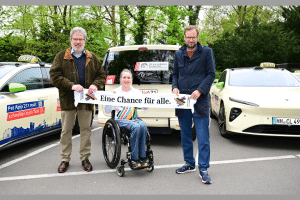
The German Social Association and the Mobility Association VSPV have called for the statutory anchoring of a so-called inclusion taxi in the Social Code IX. In a joint letter to the Federal Minister for Labour and Social Affairs, Bärbel Bas, the associations advocate introducing the inclusion taxi as a fare-free transportation service with clearly regulated federal funding responsibility.
According to the associations, severely disabled people with the corresponding entitlement already have a right to free transportation in public transport. However, this entitlement would be hollow if those affected could not practically use the scheduled services.
Claim without practical usability
The statutory entitlement is laid down in the Social Code IX and ties to the actual usability of a means of transport. In practice, however, there is often a lack of barrier-free offerings, especially in rural areas. Stops are not comprehensively accessible, and the network is sometimes not dense.
For people who could not use buses and trains due to their disability, the formal entitlement to free travel would thus remain effectively ineffective. Individual approvals, applications to health insurance funds or municipal special programs did not constitute a systematic solution from the associations' perspective, but led to additional bureaucracy and legal uncertainty.
Inclusion Taxi as a System Complement
The associations understand the Inclusion Taxi as a functional supplement to the existing regulations. Section 228 of the Social Code IX establishes the entitlement to free transportation, Section 230 of the Social Code IX defines the permissible means of transport. An addition of the Inclusion Taxi would, in their view, not create a new entitlement to benefits, but enable the practical implementation of an existing entitlement.
Funding at the Federal Level
Central for the associations is the question of cost bearing. Since this is a federally regulated entitlement, the federal government must also bear the financing. Transferring it to states or municipalities would, in their view, undermine the principle of connexity. In addition, they point to the structure of § 234 of the Social Code IX, which refers to the legal competence.
The associations estimate the annual financing need at around 70 million euros. In view of the intended societal impact and possible avoided downstream costs, this amount is acceptable.
Investment Security for Accessible Fleets
A clear federal statutory funding would, according to the associations, create investment security for the development of accessible taxi fleets. Without reliable framework conditions, a nationwide expansion of such offerings would not be possible.
In addition, the organizations propose nationwide start-up funding for vehicle conversions as well as binding quality and digital standards.
Consulting services for associations, licensing authorities and companies could be bundled in independent bodies.
The associations urge the Federal Minister to address the issue politically and to examine the anchoring of the inclusive taxi in Social Code IX, including a clear federal statutory funding responsibility. (Source: Sozialverband Deutschland / VSPV)
Content automatically translated.




Taxi-Fahrzeuge (Pkw) , Taxi-Newsletter, Taxameter, Taxi-Fahrer , BZP – Deutscher Taxi- und Mietwagenverband , Straßenverkehrsordnung (StVO) , Krankenbeförderung , Weiterbildung , Taxi-Konzessionen , Verkehrspolitik , Mietwagenbranche , Taxi-Apps , Berufskraftfahrer-Qualifikations-Gesetz BKrFQG) , Taxizentralen , Personal, Gehälter, Arbeitsschutz , Wirtschaftsnachrichten , Werbung , Taxi-Folierung , Taxi-Umrüster , Straßenverkehr , Elektromobilität, Taxifuhrpark und -flottenmanagement , Taxi-Versicherungen , Hybrid, Diesel, Erdgas , Taxi-Magazin







