


2 Ausgaben kostenlos für Sie

Fachmagazin taxi heute: Ihr Zugang zu exklusiven Inhalten rund um die Taxi- und Mietwagenbranche.
Aktueller Termin

Meist gelesen
BVTM calls for changes to the emergency reform.
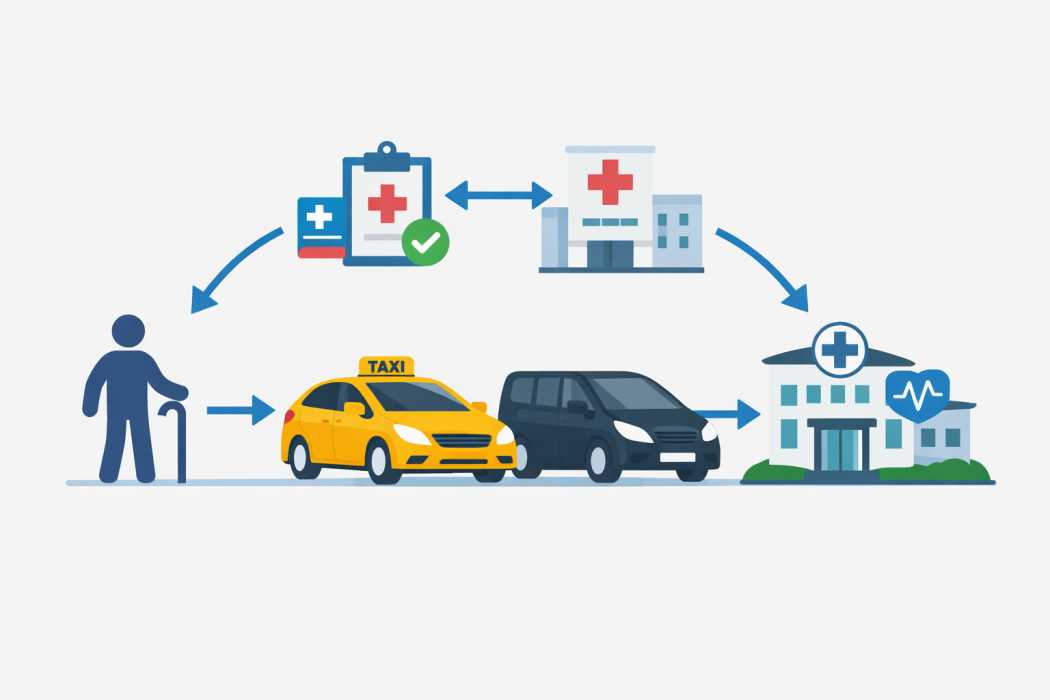
Taxi and rental car companies are, from the perspective of their national association, an indispensable component of medical care. In a statement on the draft bill of the Federal Ministry of Health on the reform of emergency care, the association notes that its member companies perform around fifty million patient rides annually and thus, particularly in the outpatient sector, play a central role.
The association welcomes the planned reform in principle, but emphasizes that it can only take effect if all involved providers are integrated in a legally secure and economically viable manner. This explicitly also applies to patient transports under § 60 of Book Five of the Social Code (SGB V).
Legal certainty for bedridden patient transports
The association regards the unclear regulations for bedridden patient transports without medical supervision, but with technical equipment such as stretchers, as problematic. In the association's view, legislation must clarify that such transports are permissible as long as no medical professional care is required. Otherwise, regional differences in interpretation, reimbursement disputes, and gaps in care would be at risk, for example for dialysis or oncology patients.
Co-payments burden companies
Another focus of the position paper concerns the co-payments for patient transports. In practice, these often lead to payment defaults, which almost exclusively affect the operators. The driving staff cannot check the patients' exemption status nor calculate the correct co-payment amount. The association therefore proposes to transfer the collection of co-payments entirely to the health insurance funds.
Reducing bureaucracy in approvals
The common approval procedures for regularly necessary trips are also criticized. Annual or semi-annual approvals for dialysis, chemotherapy, or radiotherapy place an additional burden on severely ill patients. The association advocates for long-term approvals as long as the route or the means of transport do not change.
Remuneration and Wages in Focus
The association has clearly expressed its view on the continued planned linkage of remuneration to the development of the basic wage sum. In view of sharply rising costs, including for vehicles and special fittings, this instrument is no longer appropriate. In addition, it must be clarified that collectively bargained or tariff-related wages must not be regarded as uneconomical in order to retain skilled workers.
Call for Redrafting of § 133 SGB V
Finally, a sole guideline-making competence of the health insurers is rejected. Instead, the association calls for parity-based framework recommendations with the involvement of service providers. Overall, the association advocates a fundamental restructuring of § 133 of the Social Code Book V, with a clear separation between emergency rescue, patient transports and medical rides. The aim is a legally secure, fair and practically viable design of patient mobility. (Source: Bundesverband Taxi und Mietwagen e.V.)
Content automatically translated.



Taxi-Fahrzeuge (Pkw) , Taxi-Newsletter, Taxameter, Taxi-Fahrer , BZP – Deutscher Taxi- und Mietwagenverband , Straßenverkehrsordnung (StVO) , Krankenbeförderung , Weiterbildung , Taxi-Konzessionen , Verkehrspolitik , Mietwagenbranche , Taxi-Apps , Berufskraftfahrer-Qualifikations-Gesetz BKrFQG) , Taxizentralen , Personal, Gehälter, Arbeitsschutz , Wirtschaftsnachrichten , Werbung , Taxi-Folierung , Taxi-Umrüster , Straßenverkehr , Elektromobilität, Taxifuhrpark und -flottenmanagement , Taxi-Versicherungen , Hybrid, Diesel, Erdgas , Taxi-Magazin







