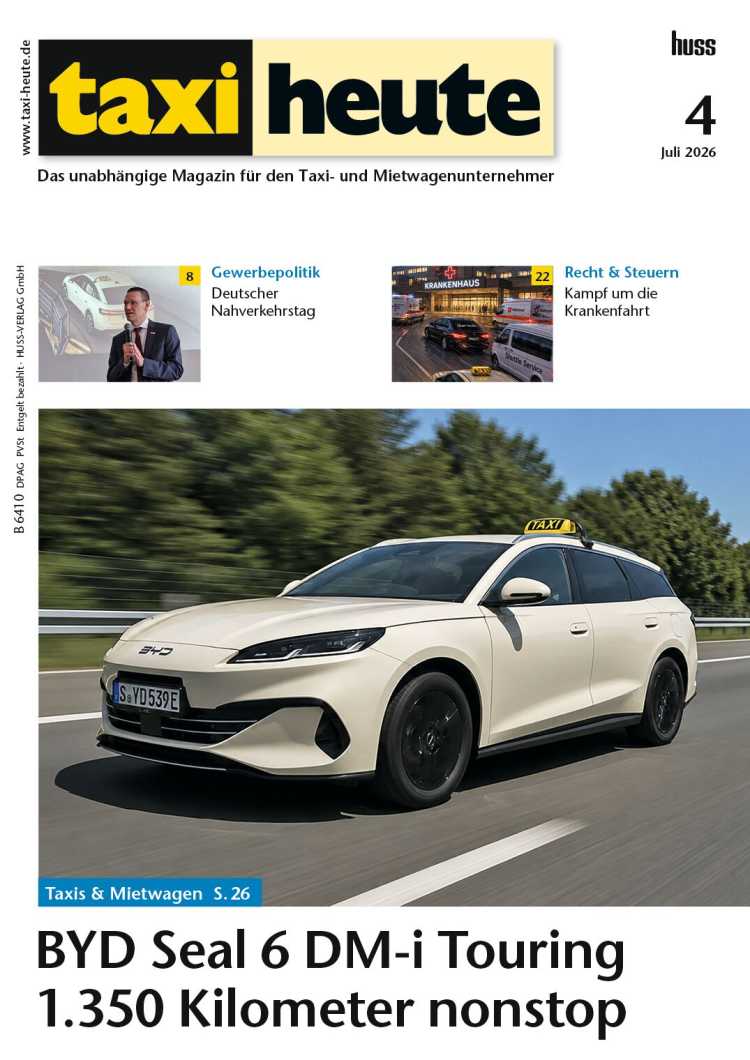
2 Ausgaben kostenlos für Sie

Fachmagazin taxi heute: Ihr Zugang zu exklusiven Inhalten rund um die Taxi- und Mietwagenbranche.
Aktueller Termin

Meist gelesen
New registrations January 2025: Increase in electric vehicle registrations only a pull-forward effect

"An increase in pure electric registrations by half compared to the same month last year is no cause for joy - the numbers are misleading about the true situation of the current development," comments Thomas Peckruhn, Vice President of the German Central Association of Motor Vehicle Trade (ZDK), on the registration figures for January 2025 published today by the KBA.
"In order to achieve the CO2 fleet targets that apply from this year, manufacturers have shifted registrations of electric cars, both BEVs and hybrids, from last year to this year. This is a special effect that does not reflect our order situation."
Peckruhn therefore expects another slump in registration numbers. "Only in the second half of the year will manufacturers significantly increase discounts again, should the penalty payments remain in place."
Uplift in the Distant Future
After the sales figures for fully electric cars plummeted by around 30% in 2024 compared to the previous year, January 2025 managed to surpass the same month of the previous year with 34,498 newly registered BEVs, an increase of 53.5 percent. With 207,640 units sold, the passenger car market is 2.8 percent below the value of the previous year’s month, with the share of fully electric cars at 16.6 percent.
A boost that is by no means sufficient to achieve the politically prescribed targets. To reach the goal of 15 million fully electric cars by 2030, a continuous increase in new registrations of at least 50 percent per year would be necessary. The share of BEVs in the passenger car market would need to be at least 70 percent. Today's figures are far from that.
Combustion Engine Phase-Out by 2035 Unsustainable
"It requires significantly more political will than the coalition government has shown in the past two years to improve the framework conditions for electromobility in Germany," said Peckruhn.
The ZDK is calling for measures that go beyond purchase incentives for price-sensitive buyer groups. In particular, charging electricity must be made cheaper, tax advantages for e-cars must be maintained, and innovation in battery and charging technology must be promoted. With approximately 150,000 public charging points today, the political goal of one million charging points by 2030 is increasingly out of reach. However, this is a crucial factor for the success of electromobility in Germany.
The ZDK is therefore advocating for an earlier revision of the European CO2 fleet limits, which must also take into account the slow expansion of the charging infrastructure. As of today, the de facto combustion engine phase-out for new registrations from 2035 is unsustainable.
Content automatically translated.

Taxi-Fahrzeuge (Pkw) , Taxi-Newsletter, Taxameter, Taxi-Fahrer , BZP – Deutscher Taxi- und Mietwagenverband , Straßenverkehrsordnung (StVO) , Krankenbeförderung , Weiterbildung , Taxi-Konzessionen , Verkehrspolitik , Mietwagenbranche , Taxi-Apps , Berufskraftfahrer-Qualifikations-Gesetz BKrFQG) , Taxizentralen , Personal, Gehälter, Arbeitsschutz , Wirtschaftsnachrichten , Werbung , Taxi-Folierung , Taxi-Umrüster , Straßenverkehr , Elektromobilität, Taxifuhrpark und -flottenmanagement , Taxi-Versicherungen , Hybrid, Diesel, Erdgas , Taxi-Magazin